Anatomy of a Water Heater: Every Part and What It Does

When hot water runs short, turns rusty, or stops altogether, one of about a dozen water heater parts is usually to get the blame. Knowing the anatomy of your water heater helps you identify the issue quickly, spot trouble early, and understand what your plumber recommends. That is especially useful here in Santa Cruz County, where local and state rules—like seismic strapping—apply to every water heater.
I’m Scott Duncan, founder and president of Duncan Plumbing, a Diamond Certified company that has served Santa Cruz County since 2000 under California contractor license #784642. My team handles the smoke testing, video pipe inspections, drain cleaning, and sewer line repair needed to track down and eliminate household sewer odors.
We will start with the core components that gas and electric tanks share, walk through each fuel type, look at common symptoms of worn parts, and cover the upkeep and local rules needed to keep your tank running safely. When a part needs attention, our water heater repair services cover gas, electric, and tankless models, and we also install heat pump water heaters.
Water Heater Anatomy for Gas and Electric Tanks
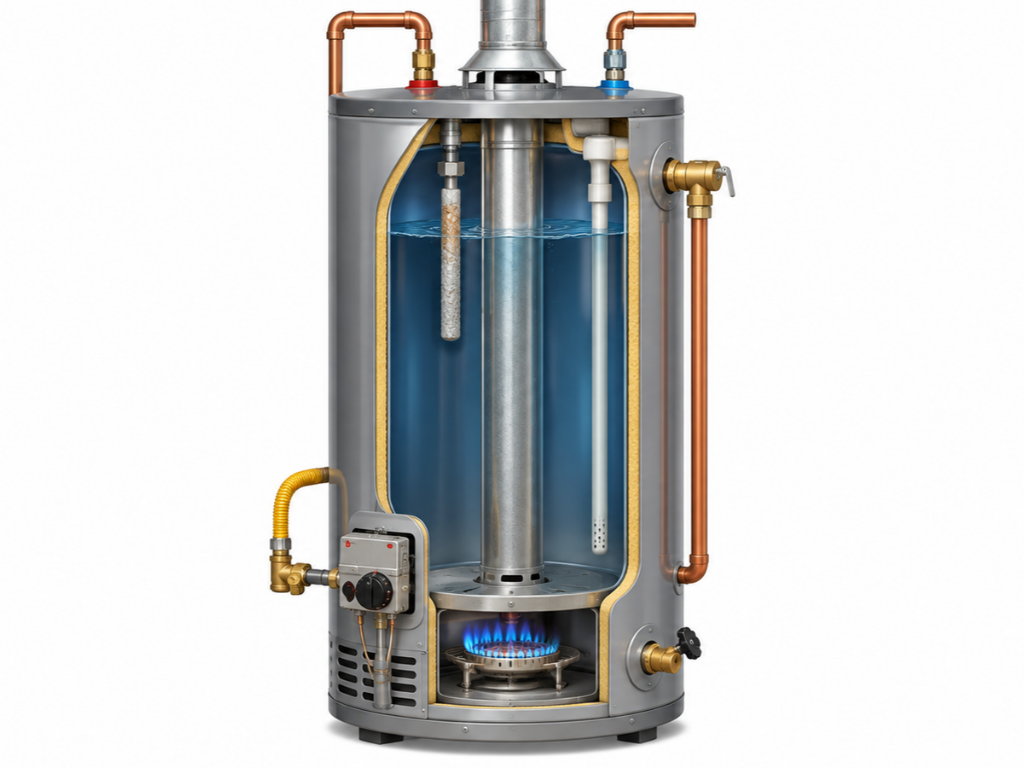
Every standard tank water heater centers on a large, insulated storage tank designed to hold hot water until you need it. The parts in this section appear on both gas and electric models.
Cold Water Inlet and Dip Tube
Cold water travels from your main supply line, passes through a shutoff valve (often called the cold water inlet valve), and enters the top of the tank. From there, the water flows down into the dip tube—a long plastic tube ending a few inches above the bottom of the tank.
Because hot water rises and cold water sinks, sending incoming cold water to the bottom ensures the already-heated water stays at the top, ready for use. A cracked or detached dip tube allows cold water to mix prematurely with the hot supply near the outlet. This typically results in lukewarm showers or hot water that runs out much faster than usual.
Hot Water Outlet
The hot water outlet sits at the top of the tank next to the cold water inlet, drawing directly from the hottest layer of water inside. Whenever a faucet opens, hot water exits through this line while fresh cold water flows in through the dip tube, keeping the tank completely full at all times.
Thermostat
The thermostat measures water temperature and signals the heating source to turn on when the tank cools below your set point.
Gas Models: The thermostat is integrated into the gas control valve on the front of the tank, where a dial lets you adjust the temperature.
Electric Models: Electric tanks usually feature two thermostats behind access panels (one for the upper element and one for the lower), both of which should be set to the same temperature.
The U.S. Department of Energy recommends setting your thermostat to 120 degrees Fahrenheit for most homes. This saves energy and significantly lowers scalding risks compared to the 140-degree default setting some manufacturers use.
Anode Rod
The anode rod is a long metal rod—typically made of magnesium, aluminum, or a zinc-aluminum blend—that suspends from the top of the tank. Because most tanks are made of glass-lined steel, the anode rod acts as a “sacrificial lamb.” It attracts corrosive elements in the water so they attack the rod instead of eating away at the tank walls.
The rod naturally wears away over time. According to the A. O. Smith checklist, you should inspect it at least every three years—or every year if your home uses a water softener.
Drain Valve
Located near the bottom of the tank, the drain valve accepts a standard garden hose so you can direct water to a floor drain or outdoors. As water heats, minerals settle to the bottom as sediment. Flushing the tank regularly through the drain valve clears out this buildup. This is especially vital on gas models, where a thick sediment layer sits directly over the burner and slows down heat transfer.
Temperature and Pressure (T&P) Relief Valve
The T&P relief valve is the primary safety device on any tank water heater. Most residential valves automatically open if pressure reaches 150 psi or water temperature hits 210 degrees Fahrenheit, releasing excess pressure safely through an overflow discharge pipe running down the side of the tank.
If your relief valve drips occasionally, it can indicate high household water pressure or thermal expansion. A plumber can diagnose the cause and resolve it by installing a pressure-reducing valve or an expansion tank. Because a replacement T&P valve must match the exact pressure and BTU ratings of your tank, this part should always be handled by a licensed professional.
Gas Water Heater Parts
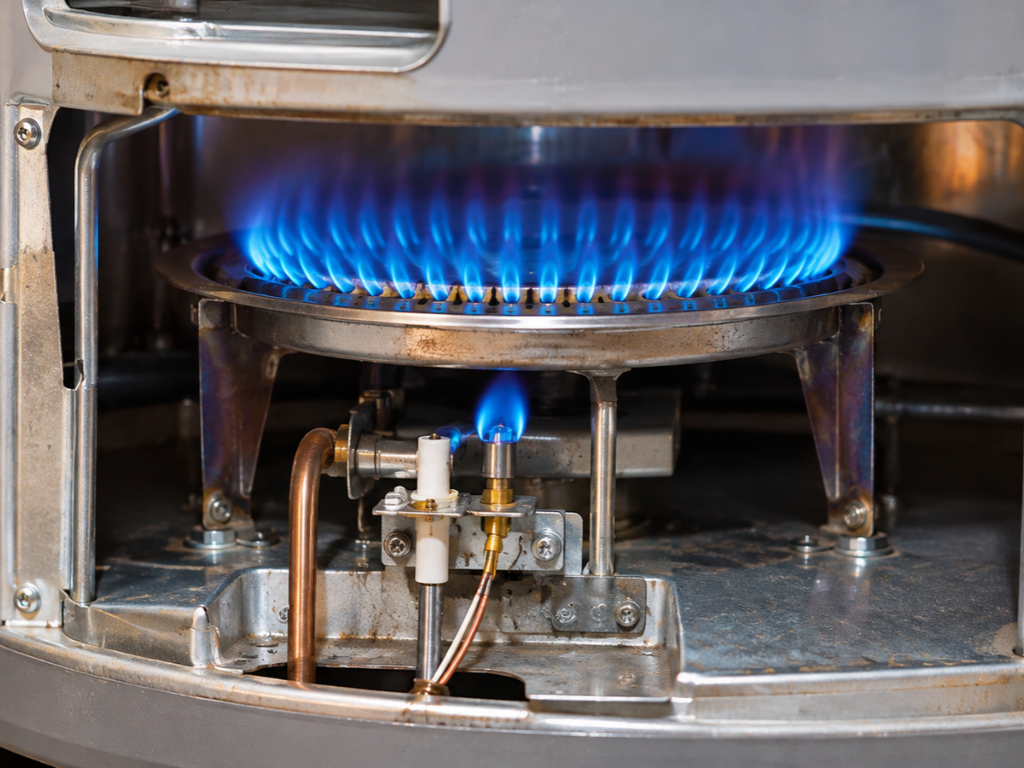
Nationwide, homes are split fairly evenly between gas and electric water heaters. The 2020 household energy survey counted 59.33 million homes using natural gas and 57.04 million using electricity. California leans heavily toward gas: roughly 79% of households in the state heat water with natural gas, according to Energy Information Administration data. A gas water heater incorporates several distinct components to ignite, control, and vent combustion gases.
Gas Control Valve
Mounted on the outside of the tank, the gas control valve houses the thermostat dial, pilot controls, and the main valve that feeds gas to the burner. It connects to an external gas supply line equipped with its own shutoff valve, allowing you to cut off gas safely during service.
Gas Burner and Pilot Light
The gas burner sits inside the combustion chamber beneath the tank, heating the water through the tank’s metal bottom. On standing-pilot models, a small continuous flame stays lit to ignite the burner whenever the thermostat calls for heat. Newer models often utilize electronic ignition systems instead of a standing pilot.
Thermocouple
The thermocouple is a crucial safety sensor with its tip resting directly in the pilot flame. The heat from the flame generates a tiny electrical current that keeps the gas valve open. If the pilot light blows out, the electrical signal drops immediately, causing the valve to shut off the gas supply. If your pilot lights and immediately goes out, testing the thermocouple, pilot assembly, and gas valve is the fastest way to isolate the problem.
Flue Baffle and Vent Pipe
Combustion exhaust gases travel up through a central flue tube running through the middle of the tank. A twisted metal strip called a flue baffle hangs inside this tube to slow the exhaust, allowing more heat to transfer into the water before escaping. A standard atmospheric water heater vents straight up through a chimney or roof flue. Properly sized and sloped venting is critical to carry carbon monoxide safely out of the home and must comply strictly with building codes.
Blower Assembly
Power vent water heaters include an electrically powered blower assembly on top of the tank. The fan actively pushes exhaust gases through a dedicated vent pipe, allowing the system to vent horizontally through an exterior wall in homes lacking a traditional vertical chimney.
Parts of Electric Water Heaters
Electric water heaters use the shared tank components listed earlier along with specialized electrical heating elements.
Heating Elements
Electric models heat water via metal heating elements that extend directly into the tank. Most residential units have two elements (upper and lower), each controlled by its own thermostat. When the tank calls for heat, the upper element warms the top portion of water first. Once that water reaches temperature, the lower element kicks in to heat the rest.
High-Limit Reset Button
Electric water heaters feature a high-limit safety switch—usually mounted just above the upper thermostat—equipped with a red reset button. If the water temperature climbs dangerously high, this switch cuts power to both heating elements entirely and stays tripped until manually reset.
Heat Pump Water Heaters
A heat pump water heater is an advanced electric tank featuring a compressor and fan mounted on top. Instead of generating heat purely through resistance elements, it pulls ambient heat from the surrounding air and transfers it into the water. It includes all standard tank components plus backup heating elements, an air filter, and a condensate drain line.
Tankless Water Heater Parts
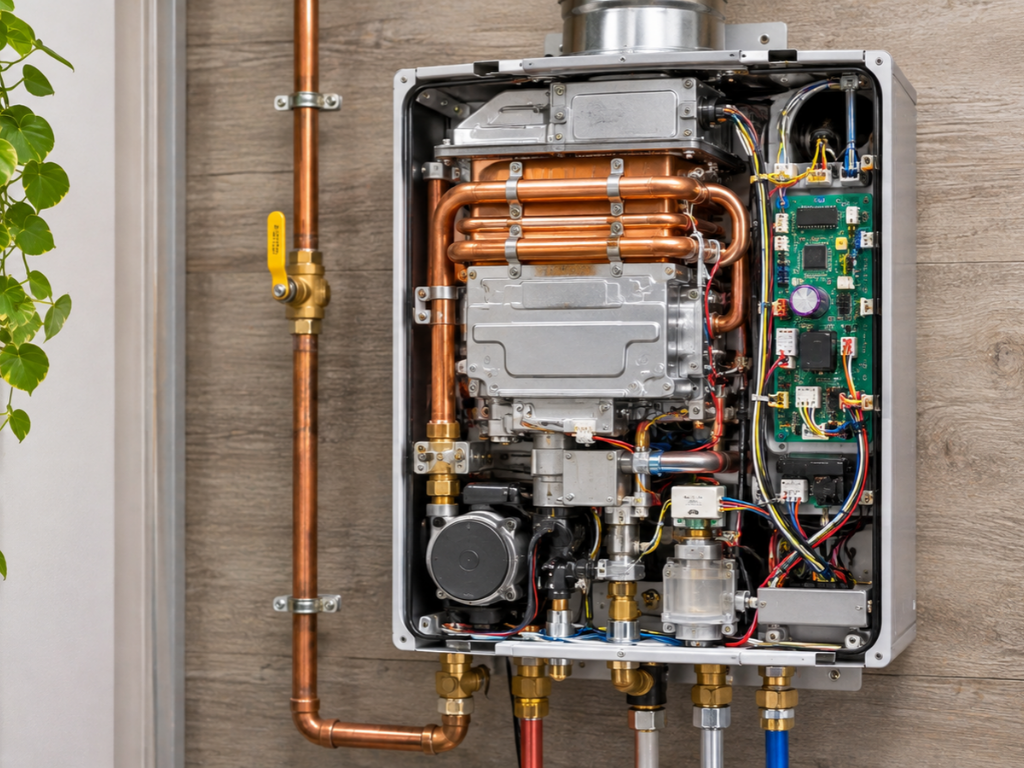
Tankless water heaters heat water dynamically on demand rather than storing it in a reservoir. Instead of a tank, dip tube, and anode rod, they utilize a compact layout designed for rapid heat transfer.
Heat Exchanger
The heat exchanger consists of a tightly wound coil or a series of water passages where heat is rapidly transferred to the flowing water. Gas models heat the exchanger via a burner, while electric models use high-powered heating elements.
Flow Sensor
The flow sensor detects movement the moment a hot water faucet opens anywhere in the home, signaling the unit to ignite or power up. Outlet temperature sensors then monitor the output, allowing the system’s computer to dynamically modulate heat levels to match your exact setting.
Control Panel
The onboard control panel and circuit board manage the ignition sequence, blower fan, and safety sensors. Many units display specific error codes here, helping plumbers diagnose and resolve issues efficiently.
Water Heater Symptoms and the Parts Behind Them

Most water heater problems can be traced back to a specific component. Use the table below to match what you are noticing with the parts a plumber will check first:
| What you notice | Parts a plumber checks |
|---|---|
| Hot water runs out sooner than it used to | Dip tube, lower heating element, thermostat, or sediment buildup at the bottom of the tank |
| No hot water (Gas model) | Pilot light, thermocouple, or gas control valve |
| No hot water (Electric model) | Circuit breaker, upper heating element, upper thermostat, or high-limit reset button |
| Rumbling or popping sounds while heating | Heavy sediment accumulation at the bottom of the tank |
| Rusty or discolored hot water | Worn-down anode rod or internal tank corrosion |
| Rotten egg smell from hot water only | Bacterial reaction with the anode rod |
| Water dripping from the relief valve pipe | High water pressure, thermal expansion, or a worn T&P valve |
Repairing a Part vs. Replacing the Water Heater
Most water heater components can be replaced individually—including the dip tube, thermostats, heating elements, thermocouple, anode rod, drain valve, and relief valve. A leak originating directly from the tank body itself is the primary exception; once a steel tank corrodes through and begins leaking, it cannot be safely patched.
Water Heater Maintenance Schedule by Part

Routine maintenance maximizes the lifespan of your equipment. The schedule below outlines the key tasks needed to protect each component:
| Part | Task | How often |
|---|---|---|
| Drain valve | Flush sediment from the tank | Once a year |
| Anode rod | Inspect and replace when worn down | Every 3 years (Every year if using a water softener) |
| T&P relief valve | Check for drips and test per the valve label | Once a year |
| Thermostat | Confirm settings are near 120°F | Once a year |
| Gas burner & vent pipe | Professional inspection of the flame and venting | Once a year |
| Heat pump air filter | Clean or wash the filter | Per manufacturer instructions |
| Tankless heat exchanger | Flush mineral scale accumulation | Once a year (Depending on local water quality) |
| Seismic straps | Check that upper and lower straps remain tight | Once a year |
California Requirements for Water Heaters in Santa Cruz County
The seismic straps listed in our maintenance schedule are also a strict legal requirement. Under the California Health and Safety Code, every new, replacement, and existing residential water heater must be properly braced, anchored, or strapped to resist shifting or falling during an earthquake.
The California Plumbing Code specifically requires strapping within both the upper third and lower third of the tank. Properly installed straps keep the tank upright so gas lines, water pipes, and venting remain intact during seismic activity.
Frequently Asked Questions
How Long Does a Tank Water Heater Last?
Most well-maintained tank water heaters last between 8 to 12 years. Performing an annual flush helps ensure your tank reaches the upper end of that range.
Why Does My Hot Water Smell Like Rotten Eggs?
A sulfur or rotten egg odor coming exclusively from your hot water typically indicates that naturally occurring bacteria inside the tank are reacting with the anode rod. A plumber can flush the tank and replace the standard rod with an alternative metal alloy (such as aluminum-zinc) to neutralize the smell. (Note: If the odor comes from all drains, see our guide on sewer gas smells).
Do Electric Water Heaters Need Seismic Straps?
Yes. California law covers all fuel types. Electric, gas, and heat pump water heaters must all be strapped at the upper and lower thirds for standard tanks up to 120 gallons.
How Can I Tell If My Water Heater Is Gas or Electric?
Gas models feature a metal vent pipe on top, a gas supply line with a shutoff valve connected to the front gas control valve, and a solid cover panel near the floor for the combustion chamber.
Electric models feature an electrical conduit running into a junction box on top and one or two square access panels on the side covering the thermostats and heating elements.
Do I Need an Expansion Tank on My Water Heater?
Water naturally expands as it heats up. In modern homes equipped with a pressure-reducing valve or a backflow preventer on the main water line, this extra volume has nowhere to expand back into the city main. This creates a “closed system,” raising household pressure and causing the T&P relief valve to drip. Plumbers install a small thermal expansion tank on the cold water line to absorb this extra pressure safely.
Key Takeaways
Gas and electric tanks share the dip tube, outlet, thermostat, anode rod, drain valve, and relief valve.
Gas units add a burner, pilot, thermocouple, and vent, while electric units use heating elements.
Most problems come from one replaceable part.
A yearly flush and anode rod checks help a tank last 8 to 12 years.
California requires seismic straps on every residential water heater.
Noticed a Change in Your Hot Water? Schedule Service With a Local Plumber
A sudden change in your hot water usually points directly to a single worn part, and our team can track it down fast. At Duncan Plumbing, our skilled professionals provide prompt, courteous water heater repair and installation across Santa Cruz County. We offer same-day or next-day service, aim to fix the issue in a single trip, and answer our phones live 24/7. Contact our team to schedule a visit.

What People Are Saying About Us